

How an Association Made AI Document Management Affordable for 700 Members

Custom AI for Small Businesses? Virtually Unaffordable.
Expert witnesses produce thousands of reports over the course of their careers. Each one is a precision piece of work: meticulously researched, technically sound, legally admissible. This knowledge sits on hard drives, in folder structures, scattered across years and various systems.
The problem: when an expert witness needs an old report — as a reference for a similar case or as evidence in court — the search begins. For hours. Sometimes without success. "I know I've done this before" is a sentence many expert witnesses know. And dread.
Developing a custom solution costs five figures. For a single expert witness firm with three to five employees: impossible. Off-the-shelf products don't fit — they understand neither the structure of expert reports nor the requirements for legally admissible documentation.
BVSK, a professional association with around 700 active member firms, recognized: this isn't an individual problem. It affects the entire industry. The question wasn't whether a solution was needed — but how it could be financed.
Heading
Lorem ipsum dolor sit amet, consectetur adipiscing elit, sed do eiusmod tempor incididunt ut labore et dolore magna aliqua. Ut enim ad minim veniam, quis nostrud exercitation ullamco laboris nisi ut aliquip ex ea commodo consequat.
The Association Invests — Everyone Benefits
The Idea: Together Instead of Alone
What a single firm cannot manage, 700 can achieve together. BVSK opted for a model that is still rare in the association world: a central investment in AI technology, made available to all members as software-as-a-service.
The principle is simple: the association bears the development costs. Members pay a moderate license fee for usage. The more members participate, the more affordable it becomes for each individual. Economies of scale that small businesses would never achieve on their own.
The Implementation: Multi-Tenant, Secure, Scalable
The requirements were clear: each user may only see their own documents. No mixing of data. GDPR-compliant. Audit-proof.
PLAN D developed a cloud-based architecture with strict tenant separation. Each user receives their own isolated environment. Documents are encrypted upon upload and stored in German data centers.
Each user can upload any number of documents — PDFs, Word files, scanned reports. The system extracts the text, indexes it, and makes it searchable. The search doesn't just find exact terms — it also understands context and synonyms.

"We are an association with 700 members, not a technology corporation. What we needed was a partner who brings technical expertise and understands that for us, it's not about a single project — it's about the benefit for everyone."
700 Members, One AI, Immeasurable Value
From kickoff to MVP took 100 days. A pilot user initially uploaded 1,500 reports — the work of over a decade. The search that used to take hours now works in milliseconds. "Water damage parking garage 2019" — three results in 0.3 seconds.
Today, all BVSK member firms have access to the AI document search. What started as a pilot project has become a core member service.
The numbers speak for themselves: in the first year, an estimated 800,000 reports will be loaded into the system. This isn't just an archive — it's the collective expertise of an entire industry, searchable for the first time.
For BVSK, the project is more than an IT service. It's a statement: associations can be innovation drivers. They can make technology accessible to their members that would be unattainable individually. They can evolve from pure advocacy organizations to technology partners.
Other associations have already expressed interest. The model is transferable: construction surveyors, environmental assessors, medical expert witnesses — everywhere there are specialists who can't find their own knowledge. Not everyone has to reinvent the solution.
Zahlen & Fakten
700+
100
800,000
< 1
So haben wir es umgesetzt
OpenSearch
Intelligent Search
Tenant Separation
Cloud Infrastructure
Document Processing
FAQs
AI-powered document management goes beyond traditional filing systems. Instead of organizing documents only by filename or folder structure, an AI analyzes the content of every document — regardless of format. PDFs, Word files, and even scanned documents are automatically indexed and made searchable by content. This means: you search for what's in the document, not for a filename. The search also understands context and synonyms.
Custom AI development requires specialized expertise in machine learning, cloud infrastructure, data security, and UX design. Development costs alone quickly reach five figures. For a firm with three to five employees, this is economically unviable. Off-the-shelf products rarely fit industry-specific requirements — such as the structure of expert reports or the demands of legally admissible documentation.
The association invests centrally in the development and operation of an AI solution. Members use it as software-as-a-service for a moderate license fee. Development costs are distributed across many shoulders. The more members participate, the more affordable it becomes per capita. What a single company cannot afford becomes achievable through the community.
Yes. The architecture is built on strict tenant separation — each user sees exclusively their own documents. All data is encrypted in storage and transit. The infrastructure runs in German data centers. This means the solution meets the requirements for audit-proof archiving under GoBD and GDPR.
The system processes all common document formats: PDF, Word (DOCX), scanned documents (via automatic text recognition), and other text formats. After upload, the system automatically extracts the content, indexes it, and makes it immediately searchable. Even documents with complex layouts are reliably captured.
A standard full-text search only finds exact terms. The intelligent search additionally understands context and synonyms. If you search for "water damage parking garage," it also finds reports that mention "moisture damage underground level." Moreover, it delivers results in milliseconds — even with hundreds of thousands of documents.
Yes. The association model is industry-agnostic. Wherever professionals create large volumes of documents and need to find them later, the same approach works: construction surveyors, tax consultants, law firms, engineering offices, or medical expert witnesses. The association invests once — all members benefit.
OpenSearch is a scalable open-source search engine optimized for full-text search across large datasets. It indexes document content and enables queries in milliseconds. As an open-source solution, it avoids vendor lock-in and can be flexibly adapted to industry-specific requirements.
From kickoff to a functional MVP took 100 days. A pilot user initially uploaded 1,500 reports — the work of over a decade. The search that previously took hours worked in milliseconds from day one.
Tenant separation means that each user's data is stored and processed in complete isolation from all others. No member can access another's documents — technically prevented, not just by permissions. This is especially important for sensitive documents like expert reports that require legally binding confidentiality.
Mehr KI-Projekte aus der Praxis
700 Members, One AI
700+

Digital Strategy for 1.2 Million Members
100%

360° Customer View for Sales
2x
From AI Hesitation to an AI Roadmap
2

Price Prediction in Seconds
24h → 1 Sec.
Repair Costs in Seconds
93%
Data Strategy Instead of Data Silos
6 Months
50 Million Euros Through Data
~50 Mio. €


Expert Knowledge at the Touch of a Button
100


A Digital Future for the Energy Transition
7

AI Calculates Hail Damage
40.000+

Computer Vision in Claims Management
93 %


Mit Daten Leben retten
1,3 Stunden
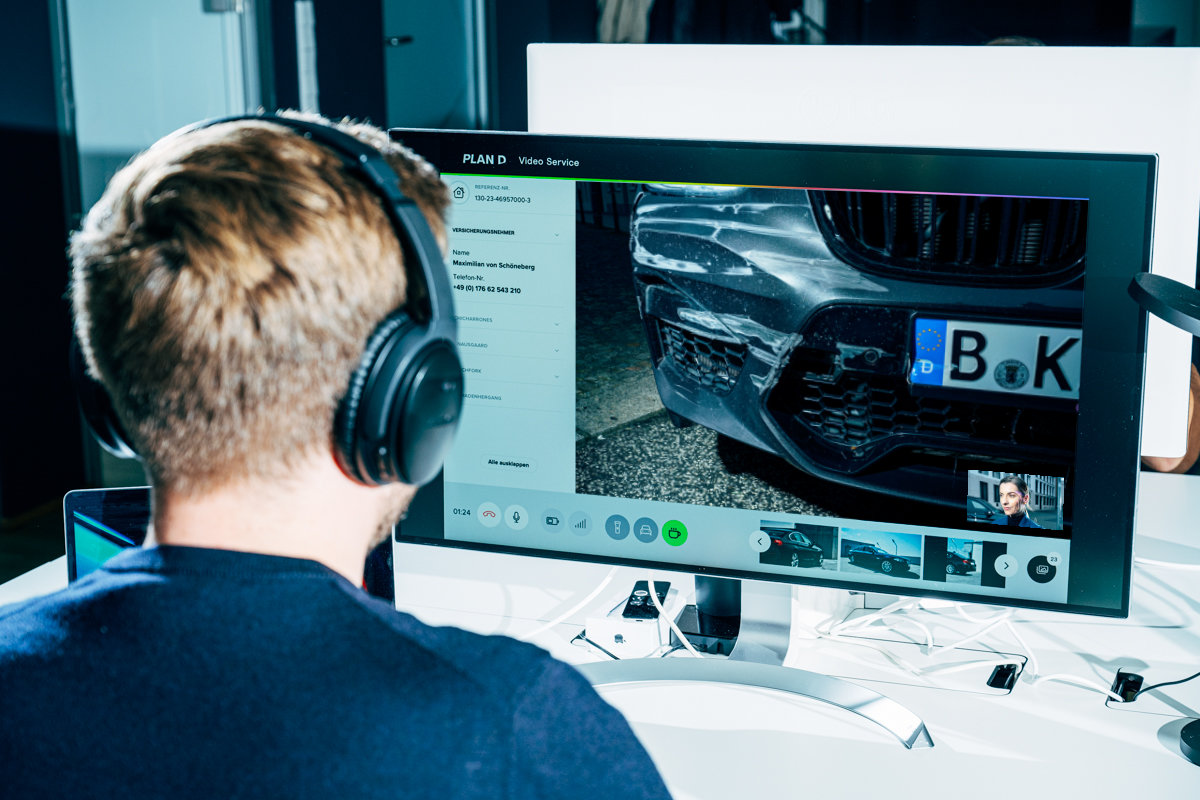

Remote Videobesichtigung von Kfz Schäden
100.000 Euro

Omnikanal im Versicherungsvertrieb
























Bereit wenn Sie es sind
Zukunft beginnt, wenn menschliche Intelligenz künstliche Intelligenz entwickelt. Der erste Schritt ist nur ein Klick.
Zukunft beginnt, wenn menschliche Intelligenz künstliche Intelligenz entwickelt. Der erste Schritt ist nur ein Klick.


KI Beratung
KI Entwicklung
KI Operations
Formate
Unternehmen
Rechtlichtes


