

360° Customer View with AI: Data-Driven Sales for 1.2 Million Customers
Data everywhere. Knowledge nowhere.
Around 1.2 million members, multiple business units, more than ten different systems. ADAC Hansa possessed an enormous data inventory: membership data, travel bookings, driving safety trainings, point-of-sale systems. But each data source told only part of the story. A holistic view of the individual customer did not exist.
For sales, this meant: consulting based on experience and gut feeling. Which member might be interested in a trip, who could book a training, who is about to cancel — no one could answer these questions based on data. Cross-selling between business units barely happened. The analysis later revealed: fewer than one percent of members used offerings from more than one business unit. An enormous potential was lying dormant.
At the same time, the question arose whether and how customer data could be systematically used at all. Many stakeholders considered data protection requirements a blocker. ADAC Hansa was looking for a partner who not only masters the technical side but also thinks through the topic of data from strategy to productive application. Not another CRM extension, but a comprehensive approach: from data consolidation through analysis and AI to a sales tool that works in daily operations.
Heading
Lorem ipsum dolor sit amet, consectetur adipiscing elit, sed do eiusmod tempor incididunt ut labore et dolore magna aliqua. Ut enim ad minim veniam, quis nostrud exercitation ullamco laboris nisi ut aliquip ex ea commodo consequat.
From data silos to a 360° customer view
Data Consolidation and Analysis
PLAN D systematically accessed all relevant data sources of ADAC Hansa: membership databases, travel booking systems, booking data from the driving safety center, point-of-sale systems, and additional sources. The data was cleaned, standardized, and consolidated in a secure cloud infrastructure within Germany — personal data consistently pseudonymized. The exploratory analysis revealed for the first time what had been hidden in the silos: over 20,000 travel bookings, more than 65,000 training bookings, clear seasonal patterns, and around 1,700 individual customer journeys.
Three AI Models with Similarity Factor
A particular challenge: there was no negative training data. It was known who had booked — but not who had decided against it. The solution: a similarity factor. Instead of distinguishing between "buys" and "doesn't buy," the model compares each member with the characteristics of satisfied customers from the same segment. This produced three models: one for travel recommendations with destination, travel type, and budget prediction. One for training recommendations. And one for churn probability.
360° Sales Interface and Data Pipeline
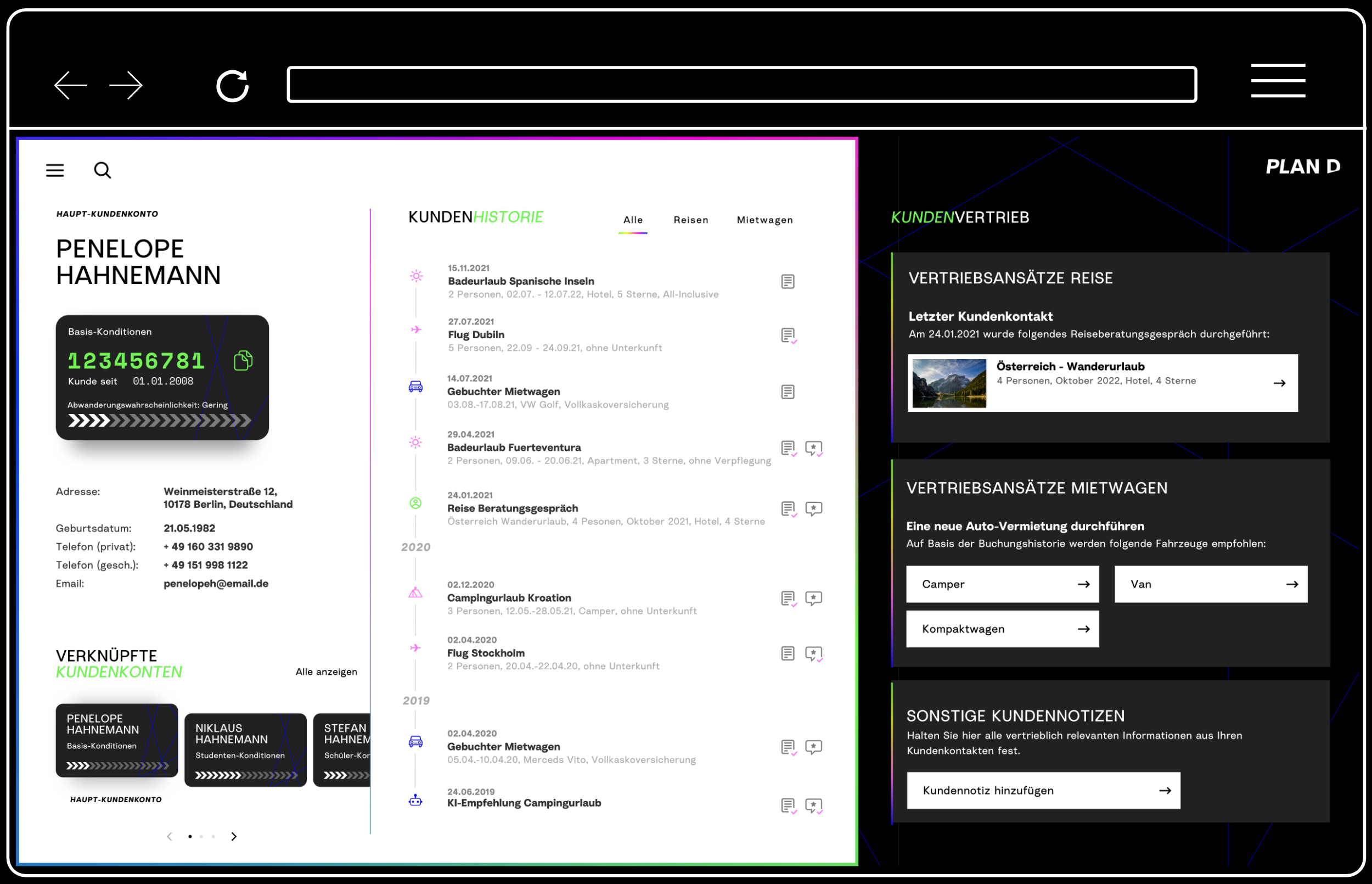
The results flow into a central 360° customer view: master data, product history, touchpoints, and AI recommendations at a glance — for each of the approximately 1.2 million members. A digital needs assessment guides sales representatives through structured consultations and automatically suggests cross-selling and up-selling measures. The underlying logic was developed in workshops with experienced sales representatives. This way, the knowledge of the best advisors becomes available to everyone. A fully automated data pipeline ensures that data and models are updated weekly. The result is not a one-off project, but a running system.

Data-driven sales with measurable impact
The 360° sales interface has fundamentally changed daily work in ADAC Hansa's sales operations. Representatives can see at a glance which products a member already uses, which recommendations the AI provides, and what the individual contact history looks like. Consulting becomes more relevant, more personal, and more effective. The measurable result: a doubling of sales conversion probability in data-driven sales.
But the effect extends beyond sales. ADAC Hansa now possesses, for the first time, a consolidated data asset that connects approximately 1.2 million customer profiles across all business units. What was previously siloed is now a strategic resource. The three AI models do not only deliver recommendations for travel and trainings, but also identify cancellation risks early. And the automated data pipeline ensures that data and models always stay current.
Most importantly: a data mindset has taken root in the organization. The experience that data creates real value motivates the company to continue on this path. From expanding with insurance data to outbound sales approaches: the foundation for future data-driven business models is in place.
Zahlen & Fakten
2x
1.2M
3
~1,700
So haben wir es umgesetzt

Exploratory Data Analysis
Machine Learning
Data Pipelines
Recommendation Engine
Frontend Development
Cloud Infrastructure
FAQs
A 360° customer view means bringing all available information about a customer together in one place: master data, product usage, contact history, preferences. Instead of fragmented data in different systems, a complete picture emerges.
For sales, this is decisive: those who know the customer advise better. Those who recognize patterns can leverage cross-selling potential. And those who spot churn risks early can take countermeasures. At the same time, a consolidated data foundation creates the prerequisite for deploying AI: only when data from different sources comes together do correlations become visible from which models can learn. Without a holistic customer view, these potentials remain invisible.
In the project with ADAC Hansa, PLAN D consolidated data from more than ten different sources and made it accessible in a central interface. The result: a doubling of sales conversion probability.
Churn prediction refers to the data-based prediction of whether a customer will leave the company. A machine learning model analyzes historical data — such as membership duration, contact behavior, tariff type, and past product usage — and identifies patterns that are typical for churning customers.
The model outputs a churn probability for each member. Sales representatives can proactively approach customers with elevated risk before they cancel. The decisive advantage: instead of reacting to cancellations, action is taken proactively.
In the ADAC Hansa project, the churn model complements the recommendation models for travel and trainings. Together, they provide a comprehensive picture of the customer situation.
Data-driven sales means making decisions in the sales process based on data and analytics — not solely on experience and gut feeling. This ranges from the question of which customer should be recommended which product to the prioritization of contacts by conversion probability.
The prerequisites: a consolidated data foundation that brings together all relevant customer data, and analytical methods that derive actionable insights from this data. AI models can generate individual recommendations that go beyond simple segmentation.
In the project with ADAC Hansa, this approach was implemented end-to-end: from data consolidation through three AI models to a sales interface that delivers recommendations directly during consultations.
Data protection and AI are not mutually exclusive — if the process is designed from the start. In the project with ADAC Hansa, PLAN D implemented several measures: personal data is anonymized before analysis. Names, dates of birth, phone numbers, and email addresses are replaced with random values, membership numbers are cryptographically processed. Data processing takes place in a secure infrastructure within Germany.
Equally important is close collaboration with the data protection officer from the very beginning — not as an afterthought, but as an integral part of the project. This produces solutions that are both privacy-compliant and performant.
A similarity factor is a machine learning approach used when no negative training data is available. Classical classification methods require both positive examples (customer has purchased) and negative examples (customer has not purchased). When only positive data exists, standard methods cannot be applied.
The similarity factor solves this problem by comparing each customer with the characteristics of known buyers. The more similar a customer is to the profile of satisfied customers in a given segment, the higher the predicted purchase probability. This approach is particularly useful in sales contexts where only purchase data but no rejection data exists.
In the ADAC Hansa project, the similarity factor was used for all three AI models: travel recommendations, training recommendations, and churn prediction.
Cross-selling potential becomes visible when customer data from different business units is brought together and analyzed jointly for the first time. This frequently reveals: the majority of customers use only a fraction of the product portfolio. In the case of ADAC Hansa, fewer than one percent of members had booked products from more than one business unit.
Exploratory data analysis identifies customer journeys, seasonal patterns, and customer segments. AI models go one step further: they calculate for each individual member which products from other business units are most likely to be of interest. This transforms an invisible potential into a concrete recommendation.
That depends on the starting point: How many data sources are there? What is the data quality? What infrastructure exists? Typically, such a project is structured in phases: data expedition and consolidation, exploratory analysis, AI model development, interface development, and production operations.
What matters is that each phase delivers standalone value. The exploratory analysis already yields insights before the first AI model is built. The consolidated data foundation is a gain even independent of the sales interface. Pragmatism beats perfection: better to start with available data and improve iteratively than to wait for the perfect data situation.
Mehr KI-Projekte aus der Praxis

700 Members, One AI
700+
Digital Strategy for 1.2 Million Members
100%
360° Customer View for Sales
2x
From AI Hesitation to an AI Roadmap
2

Price Prediction in Seconds
24h → 1 Sec.
Repair Costs in Seconds
93%
Data Strategy Instead of Data Silos
6 Months
50 Million Euros Through Data
~50 Mio. €


Expert Knowledge at the Touch of a Button
100


A Digital Future for the Energy Transition
7

AI Calculates Hail Damage
40.000+

Computer Vision in Claims Management
93 %


Mit Daten Leben retten
1,3 Stunden

Remote Videobesichtigung von Kfz Schäden
100.000 Euro

Omnikanal im Versicherungsvertrieb























Bereit wenn Sie es sind
Zukunft beginnt, wenn menschliche Intelligenz künstliche Intelligenz entwickelt. Der erste Schritt ist nur ein Klick.
Zukunft beginnt, wenn menschliche Intelligenz künstliche Intelligenz entwickelt. Der erste Schritt ist nur ein Klick.


KI Beratung
KI Entwicklung
KI Operations
Formate
Unternehmen
Rechtlichtes


