
AI Image Recognition in Motor Claims: Damage Assessment in Seconds Instead of Days
Every scratch costs. Especially time.
In motor claims management, speed and precision decide. Thousands of claims per month, each with a handful of photos, each with the same question: what's damaged, how bad is it, what will the repair cost?
Until now, a human answers these questions. Motor vehicle assessors either photograph the vehicle themselves or evaluate images submitted by policyholders via self-service claims. In both cases, the same manual process: review the photo, identify components, estimate the degree of damage. A process that works, but doesn't scale. During peak periods, backlogs build up in claims management. Turnaround times increase. Customers wait for their claims settlement. Repair costs per claim grow, the combined ratio rises with them.
At the same time, manual vehicle damage assessment is subjective. Two assessors confronted with the same body damage not infrequently arrive at different conclusions. This creates inconsistencies, rework, and in the worst case disputes with policyholders. Straight-through processing — the fully automatic settlement of clear-cut cases — is out of the question under these conditions.
Our client, a mid-sized insurance company, wanted to fundamentally change this process. Not with yet another claims management software that digitizes existing workflows. But with an AI solution that automates the most labor-intensive part of claims management: the initial visual assessment. The question was not whether damage detection via computer vision works. But whether it is reliable enough to base real decisions in claims management on it.
Heading
Lorem ipsum dolor sit amet, consectetur adipiscing elit, sed do eiusmod tempor incididunt ut labore et dolore magna aliqua. Ut enim ad minim veniam, quis nostrud exercitation ullamco laboris nisi ut aliquip ex ea commodo consequat.
From photo to repair cost prediction. Fully automated.
Building the data foundation
It started with our client's data treasure: over 5 million real damage images from documented claims. Scratches, dents, parking damage, rear-end collisions, total losses. The full spectrum of motor claims management. We systematically prepared, annotated, and transformed this inventory into training data for our computer vision model. Each image was labeled with precise annotations: which component is affected? How severe is the damage? What was repaired, what replaced? What repair costs were incurred, comparable to calculations per industry standards like Audatex or DAT?
Developing the AI model
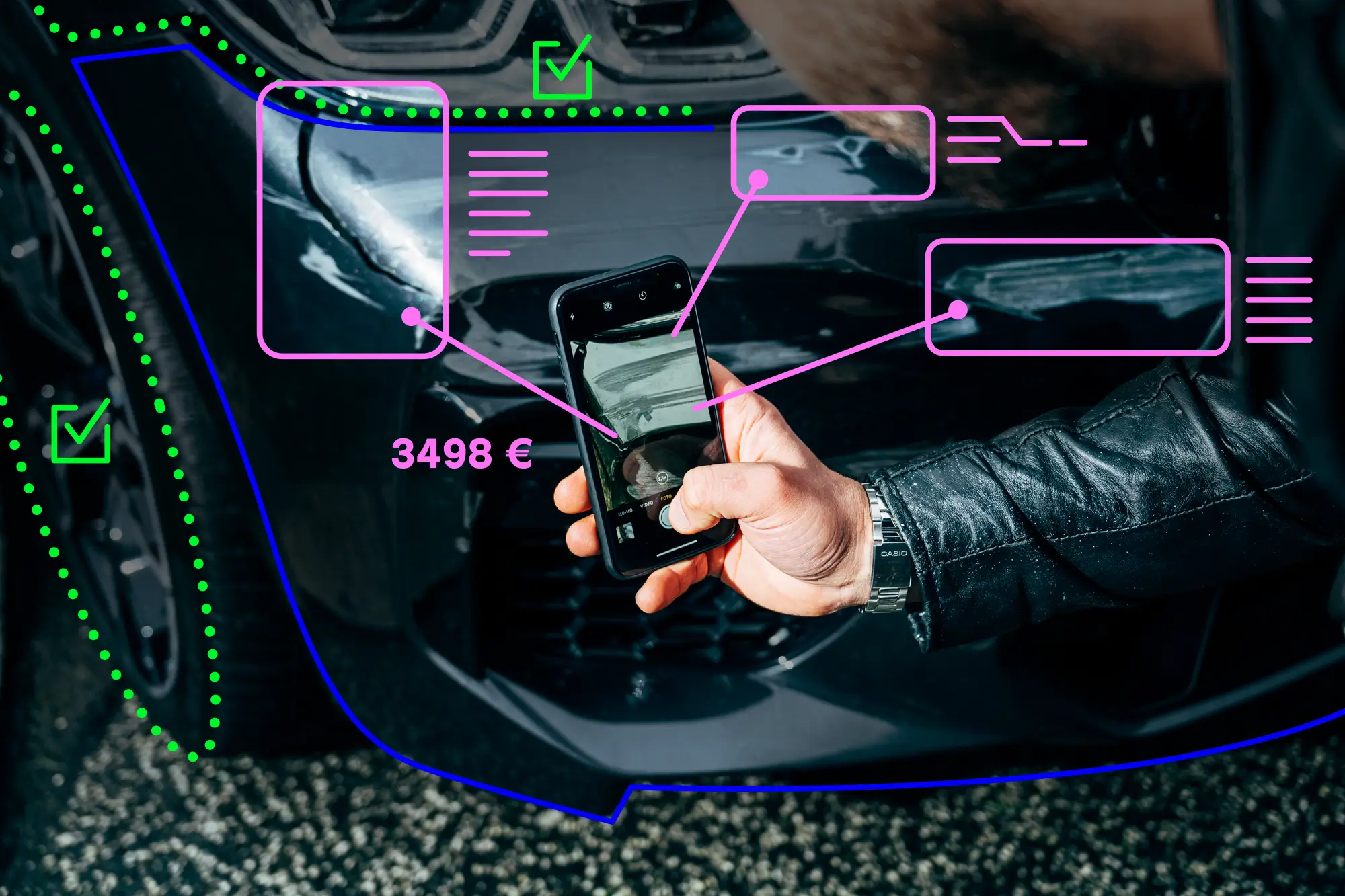
On this foundation, we developed a three-stage model for visual damage detection. In the first stage, the system classifies the vehicle: make, model, body type. In the second stage, it segments the image and identifies the visible components — bumper, fender, headlight, door. In the third stage, the model classifies the detected damage per component by type and severity: superficial, structural, or irreparable. From these three layers, the system calculates a component-level repair cost prediction based on historical claims data.
Integration into the claims process
The finished model was designed as a claims management solution that integrates seamlessly into existing claims processes. Via REST API, it receives photos: from the policyholder's self-service claim, from partner workshops, or from internal systems. Within seconds, it delivers structured results: detected components, damage grade, predicted repair costs. From FNOL (First Notice of Loss) to the assessment result without media breaks.


Faster claims settlement. Better combined ratio.
The result is an AI system that independently handles the most labor-intensive part of claims management: the initial assessment. What previously took hours or days now happens in seconds. And consistently, without subjective variation between motor vehicle assessors. In real-world testing with actual claims, the model achieves 93% prediction accuracy in component detection — comparable to experienced assessors.
The role of the motor vehicle assessor changes fundamentally: from on-site appraiser to advisor for the AI. The system evaluates each claim independently and only escalates to a human when uncertain. Policyholders photograph the damage with their smartphone, the AI delivers a result in seconds. Digital claims settlement, as InsurTech companies have been promising for years. Here, it works.
For our client, this means: shorter turnaround times in claims settlement, 60% lower processing costs per initial assessment, and measurably more satisfied policyholders. Clear-cut claims below a defined threshold go directly into straight-through processing: automatic assessment, automatic approval. No manual intervention required.
At the same time, the claims history becomes systematically machine-readable. This enables prescriptive analyses from fraud detection to predictive cost calculation. The combined ratio improves, anomalies are detected earlier. Our client is not only faster in claims processing. For the first time, they truly understand their claims data.
Zahlen & Fakten
93 %
5 Mio.+
60 %
24/7
So haben wir es umgesetzt

Computer Vision
Convolutional Neural Network
Transfer Learning
Image Segmentation
Data Annotation
Object Detection
FAQs
Visual damage detection describes the use of computer vision for automatic recognition and classification of vehicle damage based on photos. In claims management, it replaces or supplements manual inspection by motor vehicle assessors, accelerating the claims settlement process from notification to approval.
A computer vision model analyzes damage photos in three stages: first, it classifies the vehicle (make, model, body type), then segments the image and identifies visible components. In the third stage, it classifies damage per component by type and severity. The model is trained on millions of real damage images and achieves prediction accuracy comparable to experienced assessors.
The model was trained on the full damage spectrum in motor claims management: body damage, scratches, dents, parking damage, rear-end collisions through to total losses. Damage detection works regardless of the cause. What matters is the visible damage pattern in the photo.
In component detection and damage grade classification, the model achieves 93% prediction accuracy — comparable to experienced motor vehicle assessors. The decisive difference: the system is consistent. Two runs of the same photo deliver the same result. With manual vehicle damage assessment, evaluations vary depending on the assessor.
Straight-through processing (STP) describes fully automatic handling of a claim without manual intervention: from the claim notification through AI-powered assessment to settlement approval. Our system makes straight-through processing possible by automatically approving clear-cut claims below a defined threshold.
The system lays the foundation for AI-based fraud detection. Through systematic, machine-readable analysis of every claim, data patterns emerge that flag anomalies: repeated damage patterns, discrepancies between damage images and claim descriptions, or statistical outliers. Combined with additional data sources, this becomes automated fraud detection.
Yes. The system is API-based and integrates into customer apps or self-service portals. The AI evaluates every incoming claim independently. The policyholder photographs the vehicle damage with their smartphone, the model delivers a structured result in seconds. Only in cases of uncertainty or atypical damage patterns is a motor vehicle assessor consulted. Digital claims settlement, as policyholders expect today.
The EU AI Act classifies AI systems by risk level. AI in motor damage assessment typically does not fall under the high-risk category but must meet transparency and documentation requirements. Our system is designed for this: every decision is traceable, the model is auditable, and training data is documented.
The underlying computer vision technology is domain-agnostic. With adapted training data, the model can also assess building damage, industrial equipment, or infrastructure. Wherever damage is visually captured and evaluated, the approach can be adapted. For extreme weather scenarios involving mass claims, we have developed a specialized case study.
Costs depend on scope: data quality, depth of integration into existing claims management systems, and desired damage types. A typical entry point through our 100-day MVP format delivers a functioning system validated on real claims within a few months. Talk to us about your specific case.
Mehr KI-Projekte aus der Praxis
700 Members, One AI
700+

Digital Strategy for 1.2 Million Members
100%

360° Customer View for Sales
2x
From AI Hesitation to an AI Roadmap
2

Price Prediction in Seconds
24h → 1 Sec.
Repair Costs in Seconds
93%
Data Strategy Instead of Data Silos
6 Months
50 Million Euros Through Data
~50 Mio. €


Expert Knowledge at the Touch of a Button
100


A Digital Future for the Energy Transition
7

AI Calculates Hail Damage
40.000+
Computer Vision in Claims Management
93 %


Mit Daten Leben retten
1,3 Stunden

Remote Videobesichtigung von Kfz Schäden
100.000 Euro

Omnikanal im Versicherungsvertrieb
























Bereit wenn Sie es sind
Zukunft beginnt, wenn menschliche Intelligenz künstliche Intelligenz entwickelt. Der erste Schritt ist nur ein Klick.
Zukunft beginnt, wenn menschliche Intelligenz künstliche Intelligenz entwickelt. Der erste Schritt ist nur ein Klick.


KI Beratung
KI Entwicklung
KI Operations
Formate
Unternehmen
Rechtlichtes


